
Somalia
Dharoor and Sagaleh Basins – Puntland and Somaliland
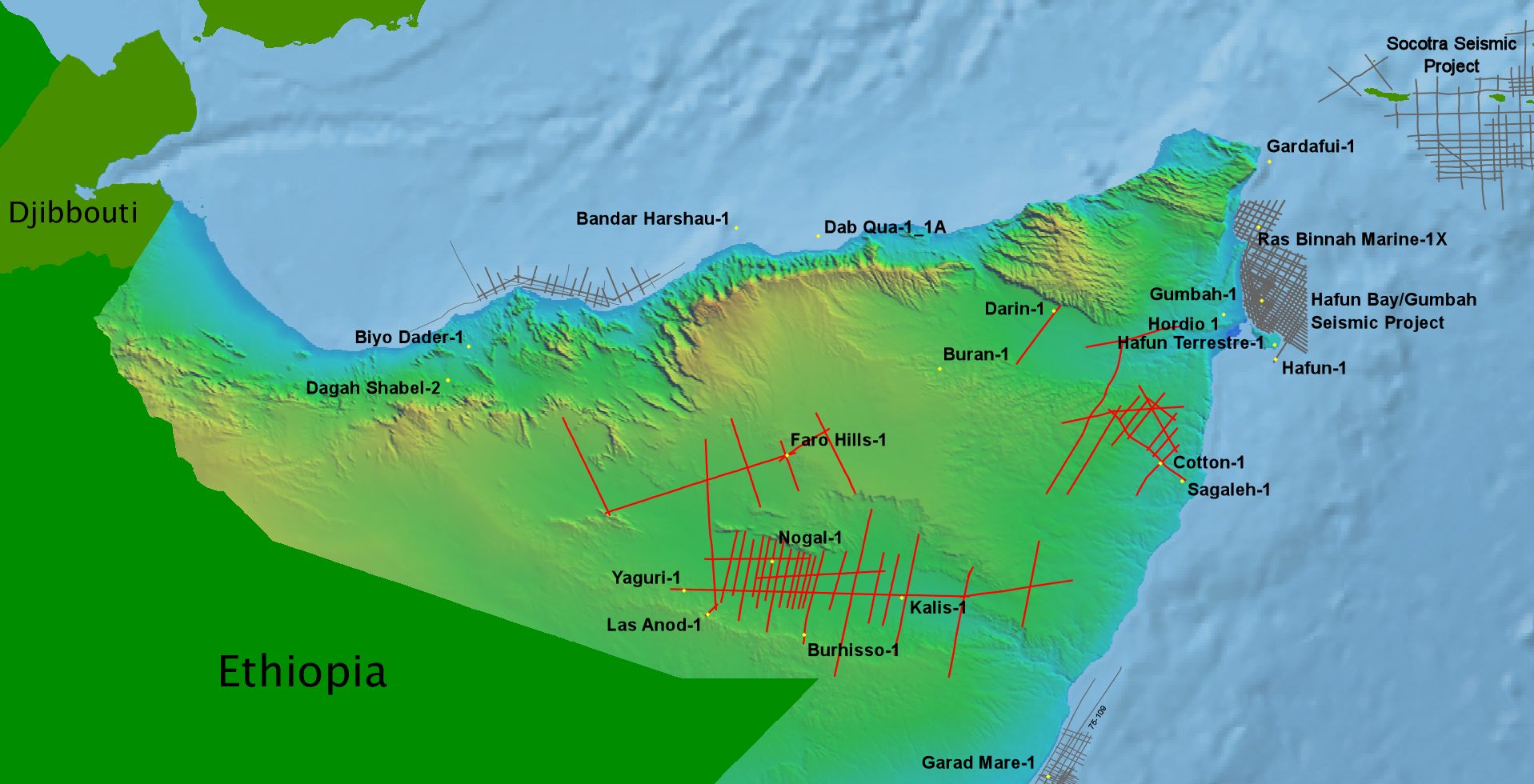
Puntland and Somaliland Overview, showing seismic and well data covering Dharoor and Sagaleh Basins.
Unlocking the Horn: Exploring the Dharoor and Sagaleh Basins of Northern Somalia
As the global search for high-impact frontier oil plays continues, the Dharoor and Sagaleh (Almado-Darror) basin systems are re-emerging as premier exploration targets. These basins, located in the northeastern region of the Somali margin, represent the conjugate side of the prolific Say’un-Masilah and Sabatain basins in Yemen, which have produced billions of barrels of oil.
Current Licensing & Geopolitical Landscape
The licensing environment in northern Somalia is evolving rapidly, centered around 2024–2026 government-to-government agreements between Turkey and Somalia. These agreements grant Turkish Petroleum (TPAO) exclusive exploration and production rights across several blocks, though legacy majors like Shell and ExxonMobil continue to engage via preliminary roadmaps for their historical concessions.
However, explorers must navigate a complex regional situation where the Dharoor and Sagaleh systems straddle the disputed border between Puntland and the breakaway region of Somaliland. While Mogadishu is internationally recognized as the sole licensing authority, its actual control over the Somaliland side remains restricted, leading to potential legal overlapping between federal awards and regional contracts issued by local administrations. To maintain neutrality and focus on technical delivery, Canesis Data provides comprehensive datasets that encompass the geological trends of both regions without attempting to define these unsettled borders.
A Proven Geological Analog
The Dharoor and Sagaleh basins are characterized by a horst-and-graben tectonic style that dates back to the Upper Jurassic and Lower Cretaceous.
- The Yemen Connection: Technical evaluations firmly establish these basins as a direct continuation of the Yemeni Jurassic rift basins, featuring nearly identical stratigraphy and structural evolution.
- Active Petroleum Systems: The presence of a working system is evidenced by major surface oil seeps and significant hydrocarbon shows in historical wells such as Nogal-1, Shabeel-1, and Kalis-1.
- Play Elements: The primary objectives include Upper Jurassic Daghani/Uarandab marine shales acting as high-quality source rocks, supplying oil to reservoirs like the Adigrat Sandstone (which showed up to 23% porosity in HAT-1) and the Upper Cretaceous Jesomma sands.
A Definitive Dataset from Canesis Data
Evaluating these high-relief structures requires the modernized, workstation-ready data that Canesis Data has successfully restored from lost archives. Our Dharoor and Sagaleh Project includes:
- Modernized 2D Seismic: A restored grid including the Dharoor/Sagaleh Project (883 km) and the broader North Onshore project (3,989 km) of wave equation migrated data.
- Critical Well Control: Digital LAS logs and final geological reports for key wells, including Darin-1, Cotton-1, Sagaleh-1, Gumbah-1, and Hafun Terrestre-1.
- Integrated Technical Reports: Comprehensive 221-page farmout reports, detailed geological studies of Block 31/M9, and interpretative packages.
- Potential Fields: Digitized and gridded gravity and magnetic datasets derived from historical aeromagnetic surveys to resolve deep basement architecture.
As TPAO conducts its drilling campaign in 2025–2026, access to this workstation-ready database is the first step in de-risking this world-class petroleum province