
Antilles (Aruba, Bonaire, Curaçao)
7000 km vectorised 2D seismic data
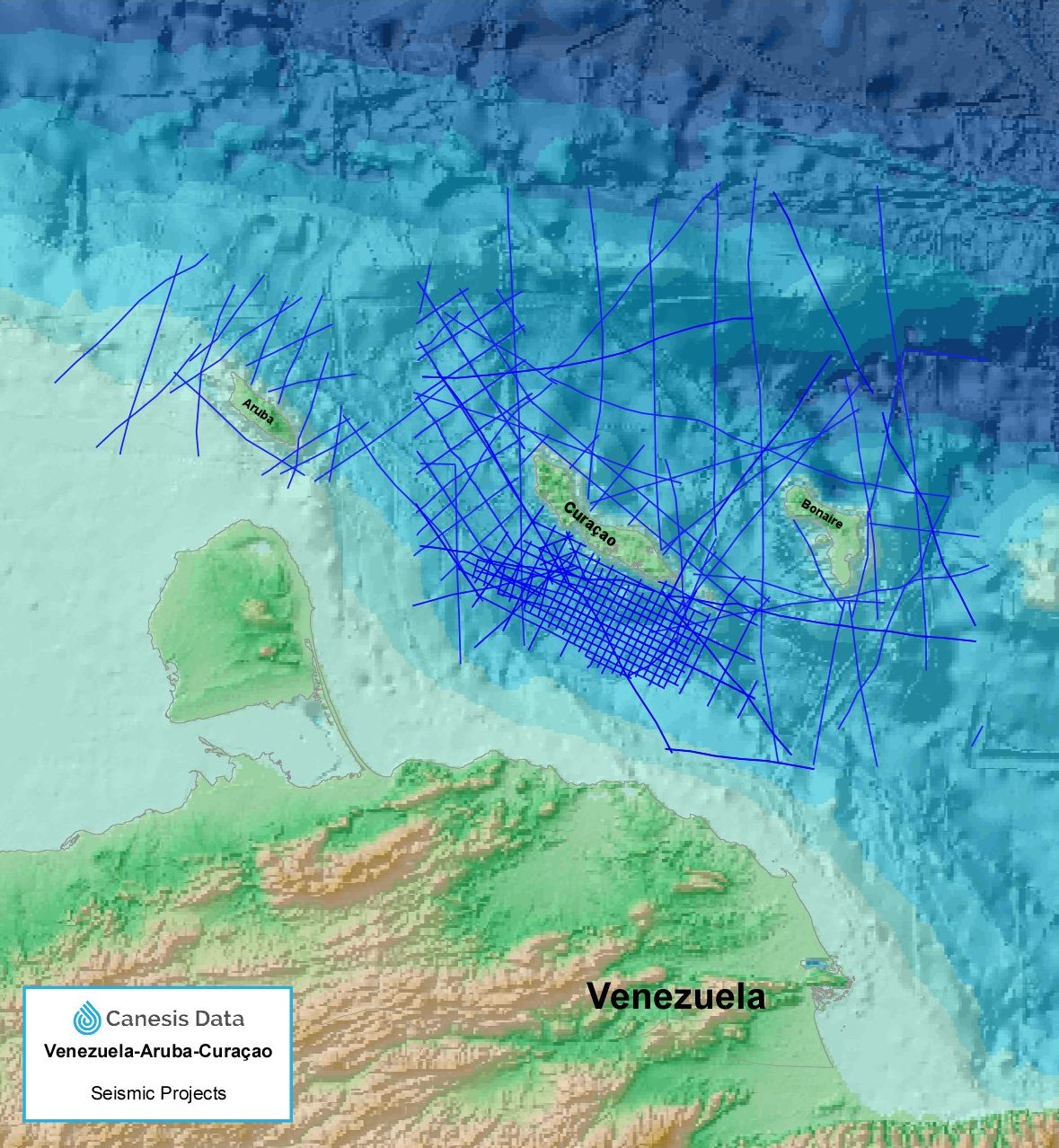
Unlocking the Leeward Antilles: 10,500 km of Critical Frontier Exploration Data
The ABC Islands (Aruba, Bonaire, and Curaçao) are no longer a “backwater” in the oil and gas industry. Following a massive surge in interest beginning May 2026, the Netherlands Antilles has become a sought-after region for exploration data. This awakening is driven by Aruba’s move toward exploratory drilling as early as 2026, spurred by a landmark agreement between Armstrong Oil & Gas and the state-owned CAP.
As explorers look to replicate the success of the nearby Suriname-Guyana basins, the foundational geological framework must be built on high-quality historical seismic. Canesis Data holds a premier archive of approximately 7,000 km of seismic data covering the Aruba, Curaçao, and Bonaire basins.
The Dataset: Comprehensive Regional Coverage
Our dataset includes several critical legacy surveys that define the structural and stratigraphic evolution of the southern Caribbean margin.
| Line Name Range | Area | Operator | Vessel | Date |
| 81-01 to 81-51 | Offshore Curaçao | BP | Western Wind | Nov-81 |
| 77-01 to 77-37 | Aruba-Curaçao | Getty/Agip/Phillips | Western Beacon | Apr-77 |
| VZ-01A to VZ-45-1 | Venezuela Borderlands | Mene Grande Oil (Gulf) | Gulfrex | Nov-74 |
| VEZ-05 to VEZ-18 | Seagap Area | Getty/Hispanoil/Agip | Midnight Coast | Jul-75 |
| C-2000 to C-2024 | Curaçao | Shell International | Petrel | Feb-74 |
| Line-01 to Line-D | Curaçao | Western Geophysical | — | Aug-Sep 79 |
Validated by Science: Use in Peer-Reviewed Publications
The surveys in our Antilles dataset are not just archival records; they are the specific data sources used to build the region’s authoritative geological models.
- The Gulfrex 2D (1974) Surveys: These lines are extensively interpreted in Gorney et al. (2007), where they were used to establish the chronology of Cenozoic tectonic events across western Venezuela and the Leeward Antilles. Interpreted Gulfrex sections appear in Figures 7 through 11 of that study to illustrate Eocene–Oligocene faulting and Miocene inversion. These data were also integral to Escalona et al. (2011) for analyzing the structural evolution of the Cariaco basin.
- Legacy 2D Grid (1977 & 1981): This grid provided the 885 km of seismic data used in the seminal study by El-Mowafy, Mann, and Escalona (2007). This research identified sedimentary successions up to 6 km thick, slope-fan reservoirs, and “bright spots” indicative of a working petroleum system in the Aruba and Western Curaçao basins.
- Tectonic Framework: Recent work by Hippolyte and Mann (2011) integrates interpretations from these offshore surveys with onland fault kinematic analysis to explain the Pliocene–Quaternary compression that moulded the ABC islands.
Why License This Data?
- Strategic Proximity: The ABC islands sit immediately north of world-class Venezuelan source rocks but offer the stable legal framework of the Kingdom of the Netherlands.
- Proven Potential: Historical interpretations of this data identified Miocene slope fans and carbonate build-ups as primary reservoir targets, models which are currently being re-evaluated for modern drilling.
- Under-Explored Frontier: With only four exploration wells ever drilled in an offshore area exceeding 14,000 km², this dataset provides a cost-effective entry point into one of the Western Hemisphere’s least-tapped deepwater basins.